
Fraynt (Friends)
A translation of Yankev Glatshteyn's very funny parody of a romantic idyll

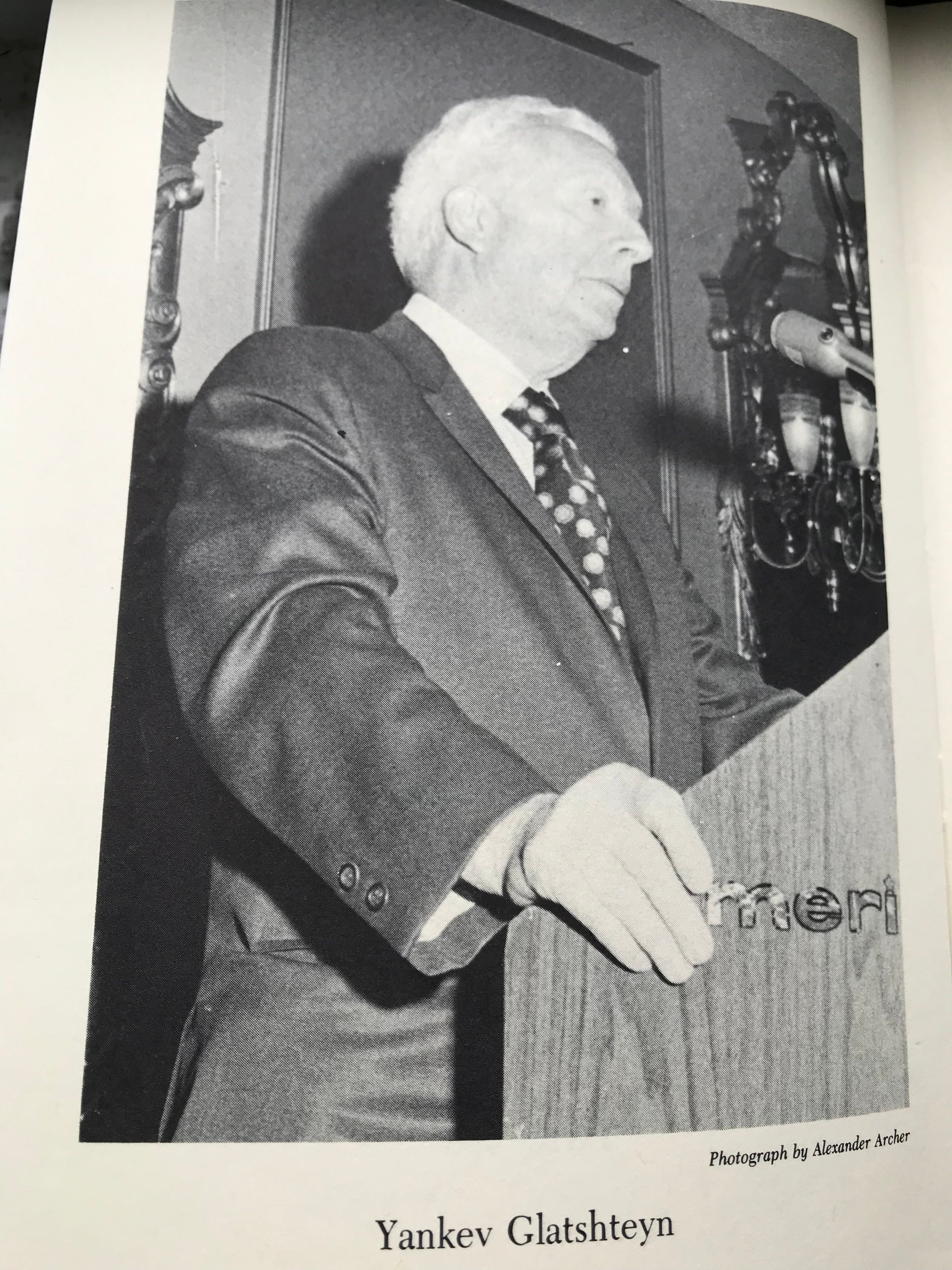
The Yiddish poet Yankev Glatshteyn, whose modernist free verse appeals to modern Yiddish readers, may not require an introduction here. It’s not a surprise that he led the way to the founding of Di Inzikhistn, a literary movement that promoted free verse and introspective individualism in Yiddish poetry. Given his preference for modernism, his isolationist argument in “The March to the Goyim” against what he calls a trend toward translation (into English)—he calls it assimilationist— appears anomalous at first. It has been explained as a reaction to his first-hand experience of Europe on the brink of WWII—sanitarium residents he spoke with forecasted the holocaust—when Yiddish and Jewish culture were marked for annihilation. But part of Glatshteyn’s argument is also that the complexity of certain Yiddish references makes accurate translation—without simplification— impossible and this is especially true of his own allusive work.
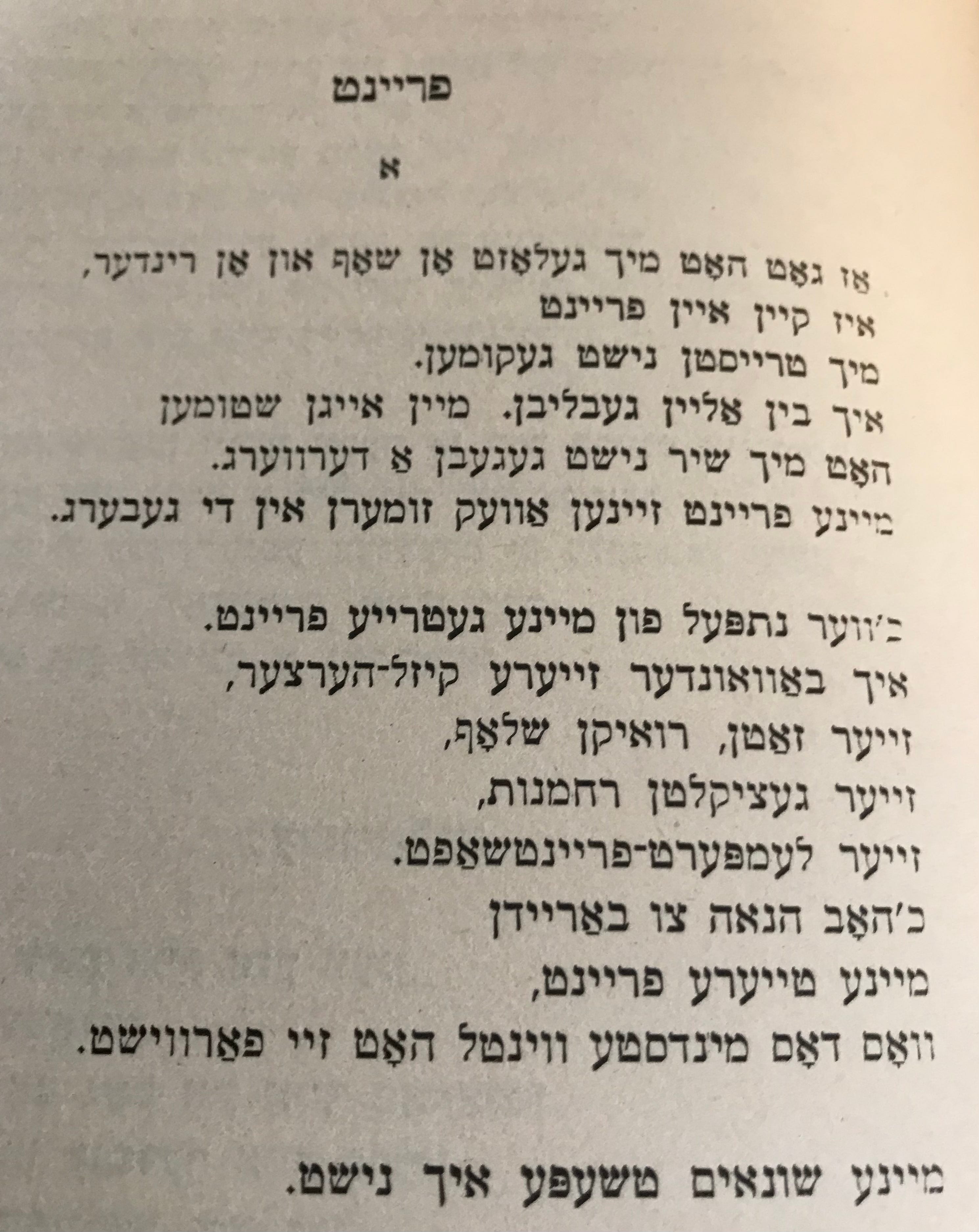
Indeed, “Fraynt” features quite a few difficult phrases and references. For example, in the opening line “un shuf in rinder” which literally means without sheep or beef, perhaps a common expression in his day but not in use in ours, immediately presents a translator’s quandary: literal or figurative. I considered food or drink but the poet’s intention seems to want to evoke more than food—he was most likely thinking of opportunities, ways to earn a living—and I settled on “nothing to gnaw on.” Gnaw gives me the reference to food, while also evoking an action that requires time, and perhaps thought, the way the writing process might.
The words “kizel” and “getzikltn” in the second stanza do not appear in any Yiddish dictionary I own. Consulting the most-knowledgeable members of my Yiddish-speaking family confirmed some of my own thoughts: The spelling of old Yiddish often transposes letters, a tzadik in place of the zayin would give me kitzel and would translate as “tickled hearts.” Then a friend from the Netherlands informed me that “kizel” is an old Dutch word for the kind of polished pebbles used as pavers, something like our river-washed flat stones. Though I was tempted to go with tickle to rhyme with fickle for “getzikltn” two lines down, I settled, for accuracy, on pebbled hearts, pebbled rather than stone or hard, for its specificity.
The Yiddish “tshepe,” in the final line of the first section, is a wonderfully evocative word and near impossible to translate well. I settled on prick.
In the third stanza, the “blood hammer” refers to Stalin’s right hand, the revolutionary Scriabin, who was known as the red Molotov (molot means hammer). Glatshteyn’s readers probably would’ve had no trouble identifying who this was.
In the fourth stanza, Glatshteyn goes for the humor of the traditional, very Jewish way of evaluating character by lineage (“Yikhes!”), in this case, the high/low lineage of a revolutionary renowned for relentless purging and for signing the Soviet pact with Nazi Germany.
The swerve from murderous socialist politics to black-hearted pirates is also witty. This final stanza opens with “chevre piraten” which I can translate as a brotherhood or gang of pirates, but neither word captures the complexity and humor of “chevre:” After the corpse in the previous stanza, “chevre” sets up the expectation of the “chevre kedisha,” an association that serves Jewish communities in the preparation of the dead for burial. Of course that is not exactly what the pirates are up to.
With the word “Kaddish” in the final line, Glatshteyn makes his way back to a variation on “kedisha,” and then finishes with “necrologue,” a compound of “necro” for death and eclogue, in other words a eulogy or obituary. He chooses eclogue to rhyme with “klog” two lines up, but using “necrologue,” Glatshteyn also reveals what he’s up to in this very unfriendly, funny friendship poem.
Theocritus is credited with inventing the pastoral eclogue in “Idylls.” Virgil adapted the form for his own “Eclogues.” In the Middle Ages, Dante and other Italian writers renewed interest in it. Edmund Spencer is considered the first English poet to master it. Finally and famously Jonathan Swift (18c) parodied the form with “A Town Eclogue.” “Fraynt” is Glatshteyn’s ironic parody of the kind of overwrought idealism readers would expect from a poem about friends.
—
Here below is my translation of Glatyshteyn’s “Fraynt.”
Friends (From Glatshteyn’s Tatn’s Shotn)
1.
When I was left with nothing to gnaw on
no friend came to console me.
I remained alone. My own voice
almost failed me. My friends departed
for summer in the mountains.
I’m astonished by my loyal friends.
I wonder at their pebbled hearts,
their sated, calm sleep,
their fickle compassion,
their leopard friendship.
I take pleasure deriding
my dear friends,
wiped out by the merest breeze.
My enemies I don’t prick.
2.
Paganini cried when he emptied his drawers
& donated his golden ducats.
The hungry don’t believe the sated man’s
energy, how he makes friends.
How he digests his rich meal,
while pitying the poor.
My sated friends come from elite lineage.
their great great grandfather was Stalin’s blood-hammer.
Seeing a friend in need
they pen great tragedies,
feel a hiccup in their thieving hearts.
Their murderous tears flow undying,
as their friend grows leaner by the hour,
until they lay shards over his eyes.
When these pirates are certain their friend is no longer,
when he can no longer move a limb,
these eloquent murderers offer elegant laments,
heap gracious shovelfuls onto the grave,
recite Kaddish & compose a necrologue.
—-
Thank you to the translator Joanna Chen for reading my translation and offering helpful comments. Thank you also to Janet Hadda, whose work on Glatshteyn is invaluable. And finally to the Yiddish Center’s Friendship Challenge, for inspiring “Prompt,” my own poem on Friends, and also this translation.
Prompt
Find a Yiddish poem or story on friendship
the contest rules say & translate it. You have
until middle October. Dabbling as a translator
from Yiddish, my mother tongue, I page through
the Lider manuscripts open on my browser
the poets I’ve been reading & find none.
It’s a goose chase, I conclude & move on
to my own work, where I find no friends either.
I try writing one & come up short. O, my friends
don’t last. They come and go fast, inspire for
an instant then become eternally distant.
For a few days in June, a sudden budding
promised, thrilled for hours, never flowered.
Humid July, another friendship bloomed & drooped.